Local soldier discharged and jailed over sexual assault

A local soldier who claimed he was suffering from the side effects of the anti-malaria drug Lariam when he sexually assaulted a female colleague, has been discharged from the Defence Forces, sentenced to seven days in prison and fined €400.

Army court martial judge Col Michael Campion also imposed “a very severe reprimand” and lifted reporting restrictions allowing the perpetrator to be named as private Barry Kingham of Dundalk.

Pte Kingham was convicted last month on one count of sexual assault on a female colleague, and two counts of behaviour prejudicial to good order and discipline.

The offences took place when Pte Kingham was on 24-hour duty with his victim and their supervising corporal at Gormanston Camp, Co Meath, in May 2010.

Discharging Pte Kingham from the Defence Forces in respect of the sexual assault, Col Campion told Pte Kingham it was necessary to “lay down a marker that behaviour like yours cannot be tolerated”.

Col Campion said military personnel needed to trust and depend on one another and the assault represented “a very serious breach of military discipline”.

He said the first count of a breach of good order and discipline, that the accused had “entered the bedspace” of his victim, was “a serious breach of discipline” and he imposed a custodial sentence of seven days detention and a fine of €300.

Col Campion said the second count of a breach of good order and discipline, that Pte Kingham had stripped down to his boxers while on duty, was the least serious charge but still a serious breach of military discipline.

Colleagues were depending on Pte Kingham to maintain a state of readiness to go on active duty, said Col Campion, and he imposed a “very serious reprimand” and a fine of €100.

The colonel also said he did not accept the defence argument that Pte Kingham’s use of the anti-malaria drug Lariam on overseas trips, particularly to Chad in 2009, was a mitigating factor.

Col Campion said a claim by Pte Kingham that the first he knew of the assault was when he found himself standing in his boxer shorts in a room as the light was switched on, with his victim shouting at him, was “self serving”, it was “not credible” and “did no service to you”.

Pte Kingham had shown “no indication of genuine insight or remorse” and, notwithstanding an immediate apology to his victim, had continued to maintain he did not know what had happened, “suggesting he has not engaged with the reality of his conduct on the night”, Col Campion said.

Defence counsel Gareth Humphreys said he would take instructions on the subject of an appeal.

During eight days of evidence Pte Kingham maintained that he had suffered depression and nightmares after returning from Chad in 2009 where he had been prescribed the anti-malaria drug Lariam.

Expert evidence was given by Dr Ashley Croft, a former adviser to the British military in tropical medicine and infectious diseases, that Lariam has been linked to symptoms of sleep loss, nightmares, forgetfulness and psychotic behaviour.

However another British military adviser, Dr Ronald H Behrens, introduced by prosecuting counsel Comdt Fintan McCarthy, said Lariam had no long-term effects and would not have been a contributory factor in the alleged assault.

Source: The Irish Times

Adams describe Ombudsman’s report on UDA gun attack as ‘incomplete’

Gerry Adams

Gerry Adams

There is no evidence that the RUC was involved in a UDA gun attack that left Sinn Féin president Gerry Adams with serious wounds over 30 years ago, the North’s Police Ombudsman, Dr Michael Maguire, has found.

Despite Dr Maguire’s findings, Deputy Adams – now a Louth TD – described his report as incomplete and asked that Dr Maguire set aside his conclusions until he had access to British Army files and other pertinent intelligence records.

Mr Adams, said in a statement yesterday: “Following the publication of several media articles in December 2006 claiming that there was collusion in the gun attack in March 1984 in which I and three others were wounded, I made a formal request to the Ombudsman’s office for this to be investigated.

“The Ombudsman also looked at two other allegations arising from newspaper reports by journalists and not raised by me. These were that the RUC knew of the attack one week in advance ‘due to a Special Branch informant’ and that the bullets were ‘doctored by the authorities to reduce their velocity and dumb them down.’ It rejected both.

“The Ombudsman’s report only deals with one of the three areas of concern that I brought to its attention in my letter of 18 December 2006.

“The Ombudsman identifies these as:

  1. ‘The RUC or security forces either had prior knowledge of the attack on him or were directly involved in the attempted murder
  2. Chief Constable Jack Hermon refused to acknowledge that Mr. Adams had been shot during a terrorist attack and didn’t issue a certificate to support Mr. Adams’ claim for criminal injuries
  3. RUC officers unnecessarily stopped and searched Mr. Adams’ visitors at the RVH, making him feel like a prisoner rather than a victim of an attack.’

“A previous Police Ombudsman had decided that two and three were not ‘grave or exceptional’ and consequently they were not investigated. This was a mistake. For a Chief Constable to refuse to confirm that a person has been shot was shameful and a grave misconduct in public office. It warranted investigation.

“Equally the treatment by RUC officers of my family and of visitors to me in the hospital was outrageous and intimidatory. It also deserved to be thoroughly investigated.

“The Ombudsman found that my allegation of collusion has not been substantiated.

“He says that there was no collusion by the RUC or ‘security forces’. But he did not have access to British Army files or those relating to the Force Research Unit which was the British intelligence agency principally responsible for running agents and informers, like Brian Nelson, within the UDA.

“The Ombudsman also acknowledges that there was ‘post intelligence (October 1984)’ that identifies UDA leaders who planned, organised, sanctioned, and supplied the weapons for the attack

“He goes on to state that this ‘intelligence was not shared with the investigating officers and as a result there was no further enquiries made in respect of the planning and sanctioning of the attack.’

“He does not investigate this or who took this decision.

“The Office of the Ombudsman also bases its conclusion that there was no prior knowledge of the attack on the denials of the would-be assassins and the fact that they were captured within minutes of the ambush.

“In my opinion this report is incomplete. The Ombudsman should seek access to British Army files and other pertinent intelligence records and set aside his conclusions until this is done.

“I will write to him formally asking him to do this.”

Members of the Ulster Defence Association, using its Ulster Freedom Fighters cover name, carried out the gun attack on a car containing Mr Adams and four other republicans as they were driving towards Belfast Magistrates Court in March 1984.

Mr Adams was hit in the neck, shoulder and arm as his vehicle was sprayed with some 20 bullets in the attack led by senior UDA figure John “Grugg” Gregg.

The driver, despite being hit, managed to escape the scene and drive to the Royal Victoria Hospital.

Dr Maguire, in his investigation, reported that Gregg and two other gunmen were arrested by an off-duty Ulster Defence Regiment soldier who was driving in the area, by an off-duty RUC officer who arrived at the scene, and by two British soldiers in plain clothes.

“We have talked to all the people involved in the events that day, including the perpetrators, the victims and the police. We have examined all the available evidence, including forensic and sensitive intelligence material and found no evidence that police knew of the attack beforehand,” he said.

Gregg and two other UDA men received lengthy prison sentences. When Gregg was released he once again became a senior UDA leader, being the so-called brigadier for southeast Antrim. In 2003 he was killed during a feud involving his mainstream UDA and a group led by Johnny Adair.

Dr Maguire conducted his investigation following a complaint by Mr Adams and after two newspaper reports stated that members of the RUC knew in advance of the attack.

Mr Adams alleged that the police or the security forces either had prior knowledge or had been involved. He said he felt “something was not quite right” about the entire incident and wondered how security force personnel “coincidentally” appeared at the scene that day.

A Police Ombudsman team spoke to Mr Adams, to the soldiers who arrived on the scene, to members of the public who saw what happened, to the two surviving gunmen who carried out the attack and to a number of retired police officers.

One of the convicted men said he had no part in planning the operation while the getaway driver said he suspected it was planned close to, if not on the day itself. Dr Maguire also reported that the off-duty UDR soldier and the two other soldiers accounted for their presence at the scene and these accounts were supported by independent witnesses.

Did you know a man in Dundalk owns a barracks?

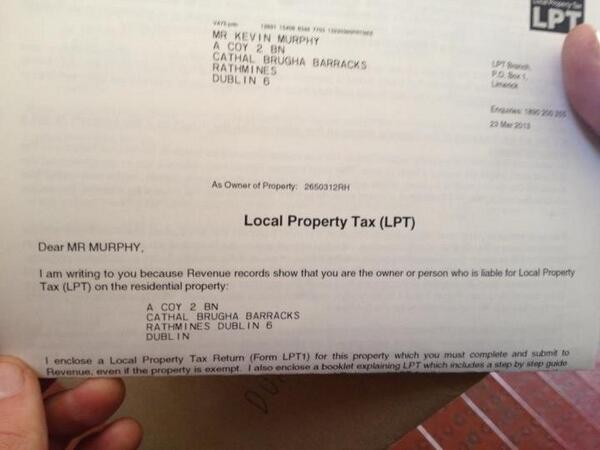
Well, he doesn’t quite own a barracks. That hasn’t stopped the Revenue Commissioners from thinking he does though with Dundalk soldier Kevin Murphy receiving a letter from them seeking a property tax for Cathal Brugha Barracks in Rathmines, Dublin 6.

I know a lot of us have been dreading the thoughts of the property tax but this really takes the biscuit!

The Revenue are seeking €427 from Mr Murphy for his digs at the barracks. You’d think they’d at least know that they own the barracks and not a regular soldier. To make matters worse, Kevin is no longer based in Rathmines either.

That’s one property tax bill that won’t be paid.

The property tax letter sent to Kevin Murphy

The property tax letter sent to Kevin Murphy